So, because I am a very particular type of person, I really like data. Anddd, I track all my writing sessions on a spreadsheet. So I thought it would be fun to share my 2025 Writing Wrapped!
A couple of explanations before we dive in:
- I try and record all my writing sessions on my computer even if they’re editing sessions, which means sometimes the word count actually goes down, but I still track it.
- I don’t record time I spend writing or editing off my computer–for example, I print off my first/second drafts and do paper edits, then transfer those to the computer. I track the latter but not the former.
- I also don’t record time I spend tootling around in my drafts, brainstorming, studying craft, writing blogs, feedbacking, browsing Reddit, crying, or any other kind of writing-related activity.
The Data
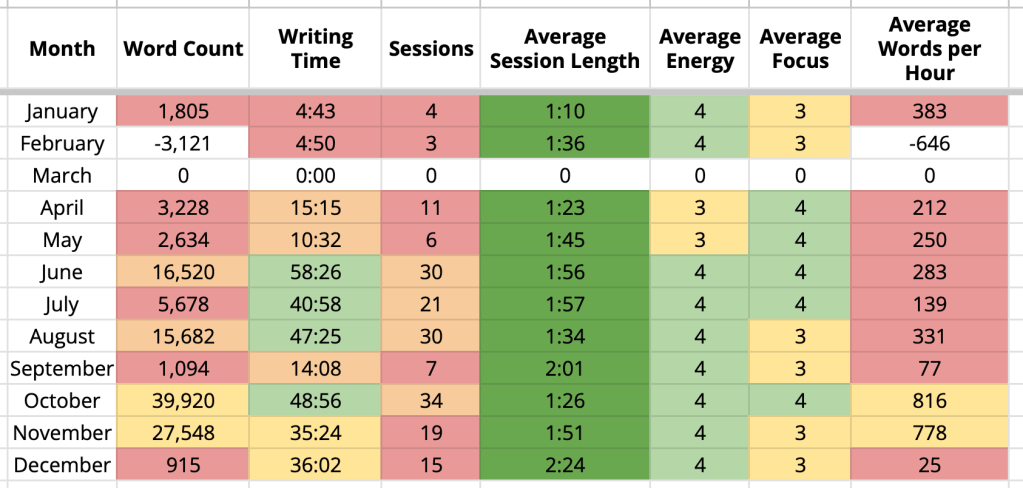
First off, the totals: in 2025 I wrote 128,607 words over 316 hours. I deleted about 16,704 words for a net total of 111,903 words.
I wrote two novels (THE FEY ARCHIVES and SPARK). I finished and edited THE FEY ARCHIVES after May 2025 and in total wrote 52,954 words and put in 136 hours into it (I already had a half-finished draft when I came back to it).
I wrote the first draft of SPARK in October/November 2025, then edited into the second draft over December and a little into January. For SPARK, I wrote 75,653 words and put in 100 hours (so far).
I also wrote a couple of short stories (which I do track) and poems (which I don’t).
The Graphs
Here’s a graph showing writing time in hours (the line) and word count (the bars). You can see months where I wrote far more (e.g. Oct/Nov when I was drafting SPARK) and months where I edited far more (e.g. Jun/Jul, December). Look at the bars go up after I handed in my PhD in March and finished my work contract in May!
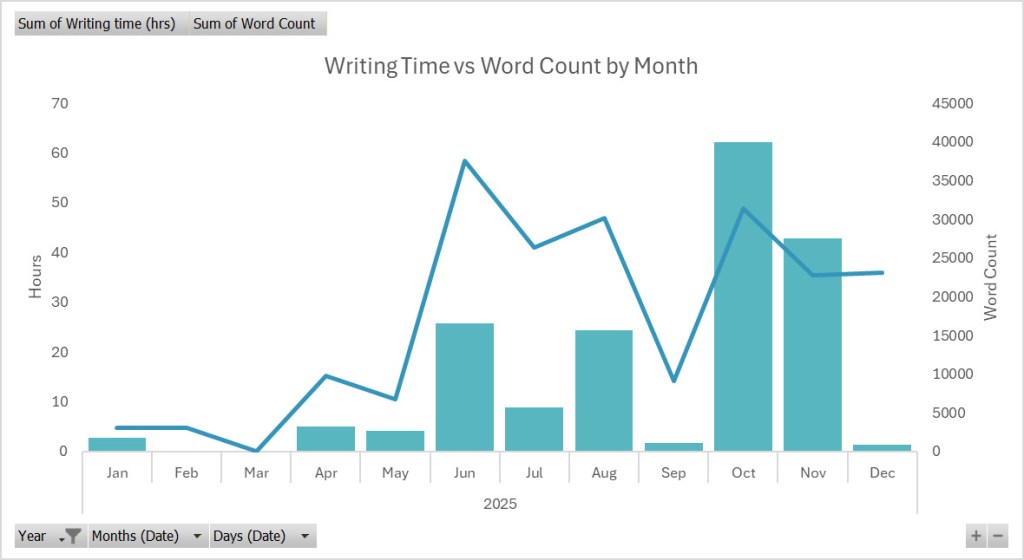
In terms of word count, my most productive month was October, where I wrote 39,920 words. In terms of writing time, my most productive month was June, where I worked on my writing for 58 hours and 26 minutes.
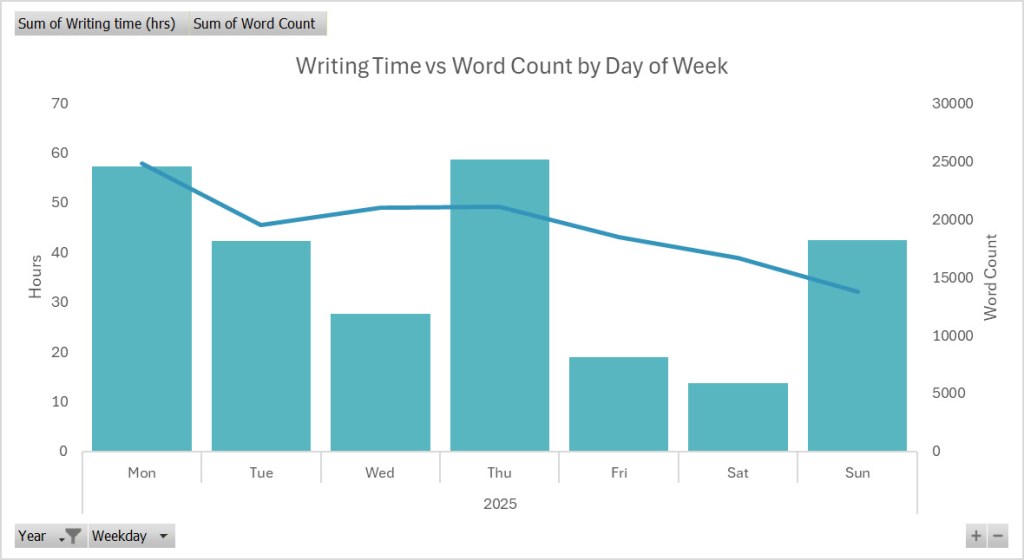
My most productive day of the week was Thursday, followed by Monday and Sunday…
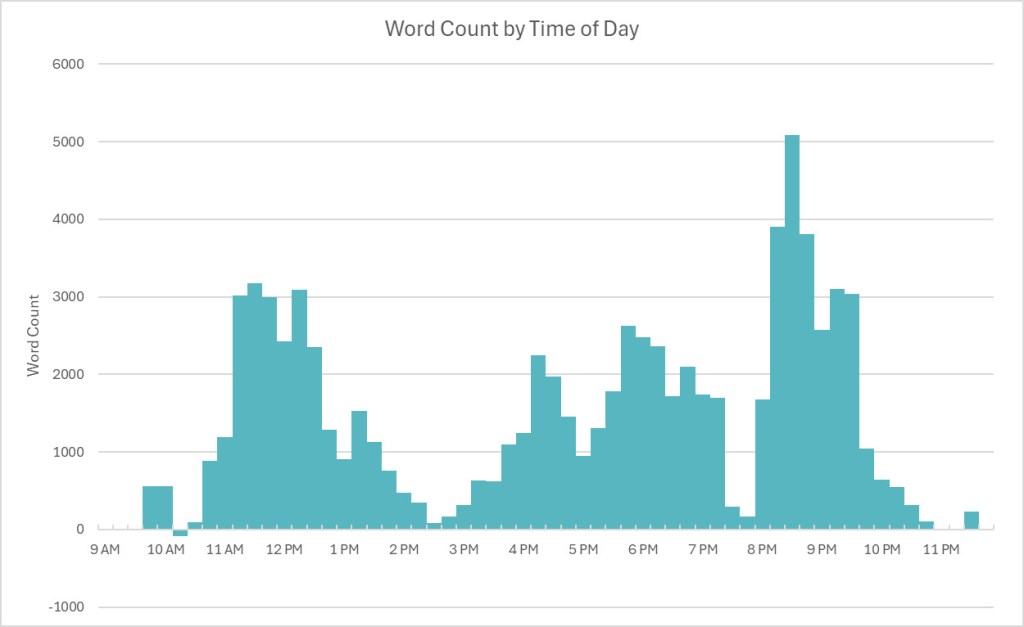
…and my most productive times are 11am–12pm and 8–9pm! Hmm, I wonder when I’m having lunch and dinner…?
What have I learned?
#1 Account for fallow periods
The rhythm of how I like to work emerges in this dataset: high periods of intensity followed by periods of rest. When I’m drafting, I can easily write between 2k-4k words a day, but that’s not a sustainable pace for longer than a week or two.
Breaks are not only important on the micro-scale (daily breaks) but also in the larger picture (like between projects). In September, for example, I took a month off writing, mostly because we were doing some renovations, but also because I had finished a project and needed a break to gestate the next.
It’s important to fill these fallow periods with rejuvenating activities like reading, watching new films, going new places, resting, going outside. Anything to fill your creative cup and let your brain recuperate from the intense energy it takes to write a story. Otherwise it’s easy to languish in a pit of despair as you fall from the high of writing a first draft back into the abyss of turning your word vomit into something readable.
#2. Find the pattern of working that suits you
I’m obviously inclined to do two sessions, one in the morning and one in the evening. I think that I edit better in the morning and draft better at night. And in between? I’m reading, doing errands, hanging out, cooking, or doing other bits of work to pay the bills.
Other people might like to work early in the morning and get it out of the way or they stay up til 3am writing in the dark. Whatever works for you and your schedule, go with it. Consistency is far more important than the “right time”.
#3. Make time
This is probably the most annoying thing about writing, but you have to show up. It takes time. A book takes hundreds of hours to write. The hours listed here only account for a fraction of the actual time spent writing a book—it doesn’t count time spent thinking, plotting, brainstorming, figuring out plot holes, staring at the bathroom ceiling while you waste away in the tub, or anything else.
You have to make that time appear from somewhere. I say no to a lot of things because I need to make time to write or even just to be on my own and think, especially in the evenings. It’s a tricky balance to figure out—and I haven’t figured it out 100% yet—but you do have to make writing a priority.
Credit
I used a spreadsheet which is freely downloadable from thespreadsheetwiz.com. You record the date, time and word count of every session as well as your energy and focus and it works out tons of stuff for you. It’s been really helpful. For 2026, I’m trialling my own sheet design which allows me to track ‘type of work’ I’m doing (e.g. drafting, tootling, revising) so I can get a little bit more granular with it.

Leave a comment